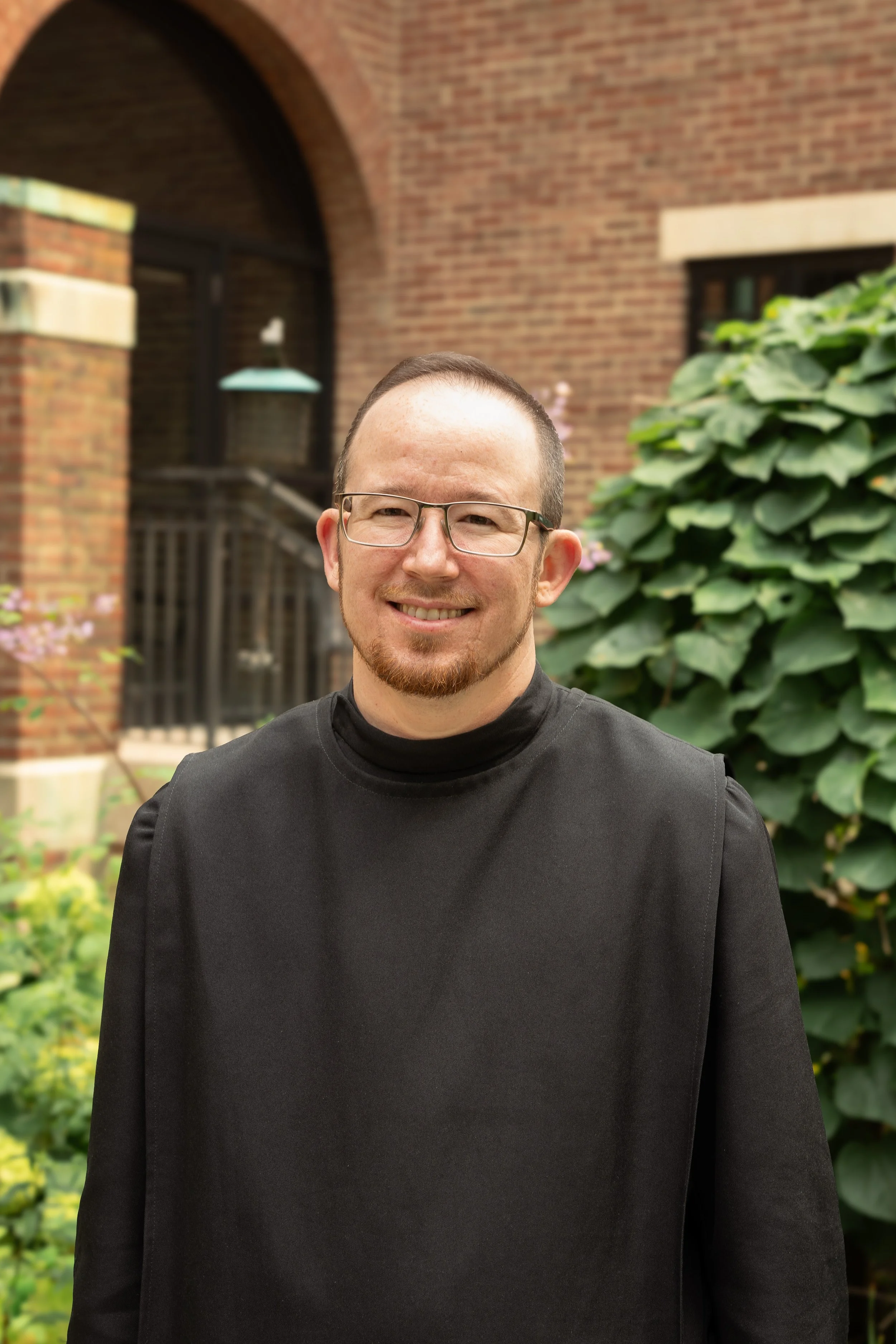
In late May, I celebrated my initial profession of the vows of poverty, celibacy, and obedience as a brother of the Society of Saint John the Evangelist. The ceremony did not enact a sudden transformation; rather, it publicly affirmed commitments I had already been living for nearly three years and asked for the gift of God’s grace to continue living them, day by day.
I have a confession to make: I wasn’t sure how good I would be at living out the monastic vow of poverty. Prior to joining the monastery in July 2023, I was a daily patron of my local coffee shop. Buying a beverage was a ritual of my morning commute, and, if a stressful workday called for a pick-me-up, I would also down a decaf version in the afternoon.
Yes, I know how to make coffee. I just prefer to buy the syrup-sweetened and milk-frothed versions that I can never satisfactorily make for myself. My coffee shop ritual was so well known that the idea of me leaving it behind caused some consternation among my colleagues. One of them came to me privately after I announced my imminent departure, inquiring with an expression of genuine concern: would my mental health suffer too much without the medicine of my daily latte fix?
Spoiler alert: I’ve survived relatively unscathed thus far, and my baseline caffeination needs continue to be met.
But going without my beloved daily latte has not been the main way that I’ve come to see the vow of poverty showing up in my daily life. Experiencing life in this community has surprised me by revealing poverty in a place I hadn't expected: that of my relationship with time and the tyranny of the to-do list.
An SSJE brother’s day is constructed around prayer. The architectural overtones of the verb “constructed” are apt. Five robust pillars of corporate prayer and worship function similarly to the granite stone walls that hold up the monastery building itself. The hour of individual contemplative time alone with God is akin to the stained-glass windows of our chapel’s clerestory. In the space inside those walls and windows, we sleep, eat, and do the business of daily life together as a community formed for the mission of inviting all into closer union with God through life in Christ.
The structure of our days—our horarium—means that we have around four hours daily to dedicate to work. By “work,” I mean specifically time sitting at an office desk typing away on a laptop, responding to emails, scheduling appointments, or making progress on writing projects. By “work,” I also mean meetings with my brothers, with SSJE’s dedicated staff team, or with outside partners about various tasks. Unlike the rope-making and basket-weaving craftwork of our monastic desert forebears, this sort of labor requires bits and pieces of coordination and communication, rather than reeds and fibers, to be woven together. Depending on your own circumstances, four hours a day may seem like an abundance, but the fact is that there are simply not enough hours in the workday to complete every task on my daily to-do list.
This fact is not news to those who have lived this life far longer than me. My elder brothers and the rest of the community in the late 1980s and early 1990s spent many years writing a new rule of life for our community. What their labors produced is a beautiful testament that offers rich food for contemplation based on the wisdom of their lived experience of vowed life. The chapters on poverty speak directly to the challenge of my to-do list, eloquently summing up the struggle:
The Spirit has many ways of making us poor and we are in no doubt that they will be costly to accept. In particular we can be sure that the Society’s life will be marked by fragility and many frustrating limitations. The resources to meet the demands made on us will seem inadequate, and our numbers too few. Our energies will seem insufficient for the claims made on them, and the task of balancing our life and husbanding our strengths too difficult. . . . God will give us our poverty.
This paragraph reminds me that I cannot blame the length of my to-do list on our contemporary instant communication, for the rule was published long before email or text messaging had penetrated daily life. And I have witnessed its truth even further back in our community’s history.
As a novice, I was assigned a research project to familiarize myself with the SSJE archives. It began with my novice guardian dropping a manila folder on my desk. As I puzzled through fragile sheets of unfamiliar cursive, I learned from the contents of the file that SSJE had been invited in 1925 to staff a mission station in the remote Filipino mountain town of Sagada. Though there was desire from SSJE’s superior at the time and support from both the chairman of the Episcopal Church’s Department of Missions and the Bishop of the Missionary District of the Philippine Islands, We were never able to say yes to the invitation.
Why? The leadership team came to realize that we were stretched too thin already. In 1925, the 13 life-professed priests of SSJE’s American Congregation were spread 8,200 miles across the globe, from Korea to San Francisco to Cambridge and Boston. Plans were underway to open mission houses in New York City (which opened in Brooklyn in 1926) and Canada (in Bracebridge, Ontario, in 1928), and vocational interest from three Japanese clergy at the same time was taken to mean that the spirit was inviting SSJE to plant a presence in Japan.
That initial foray into the archives led me to a fuller understanding of the issues and challenges facing the fledgling American Congregation of SSJE. The trials of decision-making and leadership came alive for me as I traced the written and telegraphed conversations occurring between bishops, brothers, and advisors across the globe, all happening at the pace of a world before Zoom, email, or even the advent of transoceanic telephone service.
I was surprised to discover that the issues my community grapples with in 2026 are much the same ones that SSJE’s leadership dealt with a century ago: balancing an abundance of compelling invitations for ministry with the limiting factor of community size. Another constant is an ongoing demand to articulate the mission and purpose of vowed religious life compellingly in the contemporary moment given complex issues facing church, culture, and all of creation.
I had thought that poverty would mean learning to live without my daily latte. Instead, I have discovered that it means learning to live without the illusion that I can complete everything I set out to complete. But the invitation here is not simply to make peace with the unfinished to-do list, important though that is. The invitation is to practice the deeper surrender that the unfinished list represents, that of trust in God and God’s future. For God’s purposes do not depend on my ability to accomplish every task on that list. The vow of poverty reminds me to honor the limitations of this life, and to ask for, receive, and celebrate the gift of God's grace to continue living it, day by day.