ON THE VOWED LIFE, PT. 1
I.
In the monastery that I call home, there is a red leather book in which the brothers of my religious order, the Society of Saint John the Evangelist, handwrite their vows.
The book is placed upon the altar and, in the rite of Profession, the brother and the Superior add their signatures in solemn witness.
The page reads:
Before the whole company of heaven and in the presence of this congregation, I [insert full Christian name here], reaffirm the commitment I have made, and now make my profession and promise to Almighty God, and to you, my brother, the Superior of the Society of St. John the Evangelist, and to your successors in this office, that I will live in the life-long observance of poverty, celibacy, and obedience, according to the Rule of this Society.
The same words repeat themselves on every page, yet the handwriting and the name on each page are new and distinctive. They flow with their own personality, life, courage, and surrender. Every page is the same—and no two pages are the same.
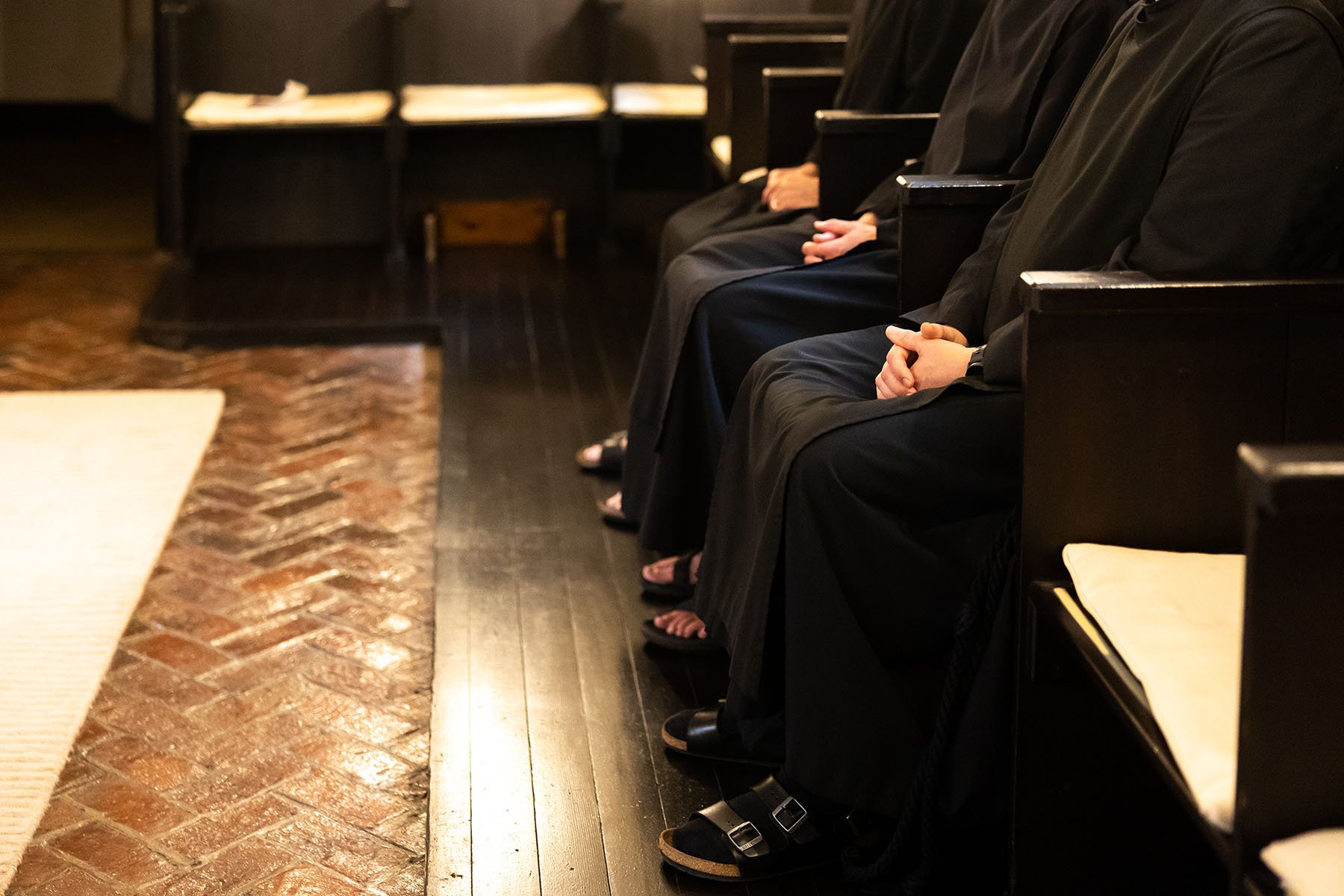
A monastery or convent is a place bristling with these paradoxes. Twelve pairs of plain black shoes—whose wearers each make a different pattern of sound as they descend the enclosure stairwell. Two hallways of cells with the same white walls and beige carpet—imbued with the distinctive life and simple beauty of each successive brother who has laid his head within it.
If it is fulfilling its deepest purpose, a monastery is a place where individuals go to lose themselves: in a life of poverty, celibacy, and obedience; in a common round of work, worship, and prayer; in a shared vision, discipline, and duty.
It is a place where individuals go to lose themselves in God.
As a novice, I would leaf through the pages of that red leather book with a mixture of awe, aspiration, and holy dread. If I merely considered the statistical likelihood, some days it seemed I had a better shot at becoming an astronaut.
Did I have the strength of character and the spiritual endurance to live, work, love, and serve with these brothers for the rest of my life?
Would I ever overcome my own terminal sense of uniqueness … the fragility of my ego … the dogged persistence of that little voice insinuating that I could never be worthy of a Love this immense?
And if I were the last monk standing, in a dying monastery, in a dying church, in a dying world … could I turn off the lights and lock the door without a single regret that I had said yes to this Love, this God who had said yes and risked heaven and earth for me?
II.
The great mystery of this weird, excruciating, joyful, fulfilling, transfiguring way of life in the church is exactly what Christ promised: Those who lose their life for my sake will find it.
An individual life lost in a monastery is a life given back one hundredfold. It is a life no longer principally defined by all the outward elements the world calls “individuality,” but it is radiant with a distinctive life hidden in God from the foundation of the world. It is given gradually, almost imperceptibly, through seasons of consoling light and the most desolating shadows imaginable. It is given each new day, each hour, sometimes each moment, often most fully at the moment that it is least obvious to our outward senses.
It is given by a Savior who lost himself in the monastery of our frail and common humanity and was raised to become the Life of the world.
All the questions that arose in the silence when, as a novice, I leafed through the red leather Profession book, jostling and posturing and bickering for my heart’s sovereignty, posed dilemmas I could never solve in my own strength. That is, without the the aid of the one and only gift God deigns to give every monk: the holy insanity to make vows.
Our vows are impossible promises made in total trust that, in the act of making them, God will give the grace necessary to keep them. This happens on one momentous, public, and much celebrated occasion with a yearly anniversary. And it happens each hour that the trust is renewed and the mercy sought to live it for just one more day.
A vow is the means by which God receives our will and desire to follow and serve in a particular calling and, in response, gives us the grace and power to do so. But that grace and power are always God’s, not ours.
Eventually, I would learn that. I am still learning that. It’s just that now I have a lifetime to learn it, as fully as God is willing to teach it, this side of heaven.
III.
Consecrated religious life exists in the church to remind every baptized member of Christ’s Body that our common vocation, like that of the Teacher and Savior we follow, is self-offering.
The theological term is oblation, which the Prayer Book Catechism defines as “an offering of ourselves, our lives and labors, in union with Christ, for the purposes of God.” Oblation is a gift of self in which we hold nothing back, in the service of God and one another.
In the past ten years, we have revived a practice that was once a norm in the Society, by handwriting a prayer of oblation in that same red leather Profession book I mentioned earlier. This prayer is personal—it is intended for the brother alone to use in private.
The prayer reads as follows:
Almighty God, I, [insert full Christian name here], relying upon your infinite mercy, and impelled with the desire of serving you in a life of Poverty, Celibacy, and Obedience, do humbly seek from your goodness by the blood of Jesus Christ, that by the fire of the Holy Spirit you will receive this offering of myself, as a sacrifice of a sweet-smelling savor, through the fragrance of his divine merits; and as you have given me a good will to desire and to offer, so I pray you also to give me the grace to accomplish that which I have promised, through Jesus Christ our Lord.
In my experience making vows and witnessing others make them, there is a mystery at the heart of the vowed life. This is true whether it is lived in a monastery or outside of one. The essence of this oblation, which only you or only I can make, often reveals its beating heart only in the moment the vow is made. There is indeed the holy fear and trembling of sacrifice, which our Profession prayer captures well. But because it is an oblation in union with Christ, “through the fragrance of his divine merits,” another Life moves in ours, with the strength and the tenderness to take all that we are and use it for the life of all.