“HOME THOUGHTS ABROAD”: IN ROME WITH JOHN HENRY NEWMAN
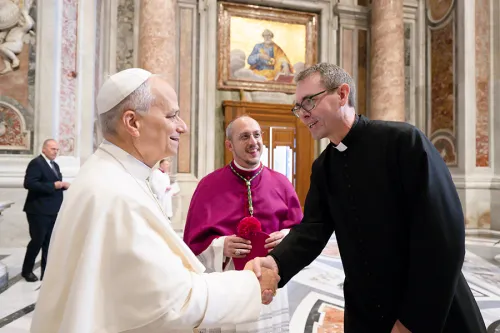
Pope Leo XIV formally greets the Rev. Benjamin King, Ph.D., at the Vatican. (Photo © Vatican Media and courtesy of Seminary of the Southwest)
They call Rome the Eternal City. So, it is no surprise that my reaction on seeing it this past November was like that of an Anglican priest who visited it in 1833. With Rome lying before him, he stood speechless while “all the many domes, which gave feature to the view before us, rose gracefully and proudly.” These words are from an article called “Home Thoughts Abroad” by John Henry Newman (1801-1890), who later in life would convert to Catholicism and in death be made a Catholic saint.
Nearly two hundred years later, the words seemed equally true to me (also an Anglican priest) as I stood in the gardens of the Urban College overlooking the domes of St Peter’s Square. Earlier that same day, I was present as Pope Leo XIV declared Newman a Doctor of the Universal Church. Although an Episcopalian, I had been invited to contribute to the process that led to this rare designation. For the cardinals and certain bishops to judge whether Newman was sufficiently eminent in holy teaching to be declared a doctor required an official Vatican document, or positio, to which we contributed.
The need for the Vatican to verify that Newman was responsible for two miracles, about which as a Protestant and a historian I had some doubts, had taken place in advance of his becoming as saint in 2019. In the summer 2024, I was told the purpose of the positio was to demonstrate in the first instance that St John Henry Newman’s teaching was widely circulated within the Catholic Church, especially that it was quoted in papal writings. It needed to show in the second instance the eminence of Newman’s theology which, in his case, underwrote certain teachings of the Second Vatican Council. My contribution came under the second heading and was about Newman’s formation in and scholarship of the early Church Fathers, and much of that had occurred when he was an Anglican priest just returned from that first visit to Rome.
I wasn’t the only Protestant to contribute to this official Catholic document: I was joined by fellow American Fred Aquino, my co-editor of The Oxford Handbook of John Henry Newman. There was one priest (me as well!) and two women among the twenty contributors, so we were by no means an all-male, clerical cabal. Truer to expectations of the Catholic Church, though, the process was secretive: we had to hold in confidence what we were contributing to and what exactly the positio said because it was for the cardinals’ eyes only.
In November 2024, the positio was sent to the cardinals, together with copies of all Newman’s many works, and the word came back that it successfully made the case. Pope Francis seemed ready to declare Newman a doctor when he fell gravely ill in early 2025 and died. But his successor Pope Leo XIV, perhaps because as an American he knows the importance of Newman Centers to Catholic students on university campuses across the US, came to the same conclusion. In July 2025, the Vatican announced that Leo would declare Newman the 38th doctor of the Church. Late in September, contributors to the positio learned that the declaration would occur at Mass in St Peter’s Square on All Saints’ Day, November 1, 2025.
A year from start to finish was, we were told, an unprecedently short time to declare a doctor of the Church. In part the speed was the result of the Vatican’s desire to make the declaration during the Jubilee of the World of Education that would bring educators to Rome in late October and early November. During the events, the pope named Newman co-patron of education with no less a theologian than Thomas Aquinas.
We were housed in the English College’s Palazzola, looking across a lake to the papal residence of Castel Gandolfo. There, like Newman when he visited Rome as an Anglican priest in 1833, my own “home thoughts abroad” occurred in discussion with my fellow contributors about the differences between our two Communions. On Friday October 31, we attended a symposium on Newman at the Pontifical Gregorian University, at which each contributor summarized our section of the positio and responded to questions from a room full of Catholic clergy, seminarians, educators, and members of religious orders. I said that Newman’s Anglican formation in the Church Fathers shaped his writings throughout his life and I recalled that he was considered the leading scholar in the world on Athanasius at the time by Protestants as well as Catholics.
A delegation from the Church of England also attended the symposium in recognition of the fact Newman is considered by the Vatican to be an ecumenical figure. The delegation, led by the Rt. Rev. Stephen Cottrell, the Archbishop of York and senior figure in the CofE right now, was recognized with great applause at the end of the seminar. (1) They joined in singing Newman’s hymn, “Lead, kindly Light,” which he wrote as an Anglican when kick-starting the Oxford Movement. At the symposium, I also learned that at the next day’s Mass I could join the Anglican delegation.
I barely slept that night because I knew that Anglicans had the best seats in St Peter’s Square! The delegation sits near to the doors of St Peter’s Basilica, level with the pope. From here, you see the outdoor altar in front of you and to your left lies the whole square filled with the faithful, stretching down towards the River Tiber. What I didn’t know was whether, along with the Anglican delegation, I would be invited into St Peter’s Basilica before the Mass for an audience with the pope. I am enormously grateful to the Rev. Martin Browne, who oversees Anglican participation in these ceremonies, for involving me.
My physical sensation as we proceeded from our seats into the Basilica was one of elation. Two contributors to the positio who had done much of the work of editing were also waiting inside, together with Fr. George Bowen the “postulator” of Newman’s cause, and we excitedly acknowledged one another across the cavernous marble interior. Behind me waited David Lammy, the UK’s Deputy Prime Minister!
The pope was standing in front of Michelangelo’s Pietà, one of the most moving sculptures in European art. Archbishop Flavio Pace introduced me to the pope as “the Anglican who contributed to the positio.” Pope Leo XIV smiled radiantly. Calling him “Holy Father,” I thanked him for this moment, and said that I brought greetings from Texas. He asked, “where in Texas?” I said “Austin,” to which he nodded in recognition. I said that I teach at an Episcopal seminary called Seminary of the Southwest. He never stopped smiling. I thanked him again and it was over.
Only when I saw the official photograph later did I notice that it had been carefully stage-managed so that over the doorway behind us was a mosaic of St Peter with the keys to the heavenly gates. The symbolism from the Catholic Church was clear: the man whose hand I shook stood in succession to the prince of the apostles. But as we Anglicans met the pope there was no sense that our souls were in danger of being shut out of heaven, as Newman himself had feared in his last days in the Church of England.
We returned to our seats outside. I had arrived at St Peter’s Square around 8:15am and by now it was 10:15. The service would begin at 10:30. The excitement was rising, and so was the sun. We were outside without shade in the Roman heat, so I baked in my cassock during the hour-and-a-half service. But it was worth it. The procession began with acolytes, then countless priests, bishops, and cardinals, and ended with the pope. Soon after the service began, the pope declared Newman a doctor of the Church and was greeted by spontaneous applause from the gathered faithful. Mass was in a variety of languages, with laity of various nationalities reading the Epistle and prayers of the people. In fact, the international aspect showed this Church at its most catholic. The pope sang the Mass and preached in Italian, and the only exceptions were when he said the words “John Henry Newman” and “Lead, kindly Light” in an American accent.
After the service, the contributors to the positio were invited to a celebratory lunch at the Urban College (a new building, so not the one in which Newman had studied for the Catholic priesthood in his middle age). Vincent Cardinal Nichols, the Archbishop of Westminster, presided over lunch and thanked the contributors warmly for our work. (2) In conversation, the cardinal told me of the enormous significance of the UK state visit as few days before at which King Charles III, the Church of England’s supreme governor, was named “royal confrater” of the Benedictine abbey of St. Paul’s outside the Walls in Rome. Added to that, a former Anglican was now a doctor of the Catholic Church, and it felt like “chipping away” at the Reformation. All of this was unthinkable a decade ago, when the Church of England began to ordain women as bishops—but it would have been undiplomatic for me, having just met the pope, to bring up other obstacles such as papal infallibility!
We contributors went into the garden of the Urban College, from whose hilltop position we saw that seemingly timeless view of St Peter’s Square and the Basilica and Vatican City behind it. Taking in that glorious view was a fitting place to recall the small part we had played in making history for the Catholic Church that day.
Also in the delegation were, the Rt. Rev. Guli Francis-Dequani the Bishop of Chelmsford, the Rt. Rev. Anthony Ball who directs the Anglican Center at Rome, the Rt Rev. Martin Warner the Bishop of Chichester), the archbishop’s chief of staff the Ven. Mark Steadman (a seminary classmate of mine I hadn’t seen in 25 years!), the Rev. Dr. Will Lamb the vicar of the University Church at Oxford where Newman had been the vicar, and the Rev. Dr. Matthias Grebe the CofE’s National Adviser for Ecumenical Relations. The Rev. Jules Cave and my fellow Episcopalian the Rev. Johnathan Denson joined from the Anglican Centre in Rome.
The guests included the ambassador to Ireland, where Newman had sought to set up a Catholic University, and Cardinal Roche from the Catholic Bishops of England and Wales who have worked so long to make Newman a doctor.