Focal Practice as a Path, Pt. 2
Article originally published in summer 2024 in Cowley Magazine.
Read the first installment of this piece here.
Though I’m a monk, I am learning (like all of us) that if I am to be critically engaged with technology, I must hold its use in proportion alongside the focal practices by which God brings me back to Life.
What I have found most enriching about Albert Borgmann’s work on focal practices is the idea that critical engagement with technology, as Christians, compels us to take up counterpractices. These weave us back into right and balanced relationships with material things in their irreducible goodness. Devices are not the enemy. They are simply so powerful, and their means of operating upon us so advanced, that we require a highly intentional context of counterpractices to flourish if we are to pursue the good life, and the godly life, in their midst.
While all focal practices engage us intimately with a world of things, I want to share just one that has been particularly instrumental in my own life of loving relationship and reciprocity with creation. If creation is the “material expression of God’s love,” this has been a counterpractice safeguarding my love for creation as an ultimate concern, in a world that routinely reduces creation to inert matter or expendable resources.
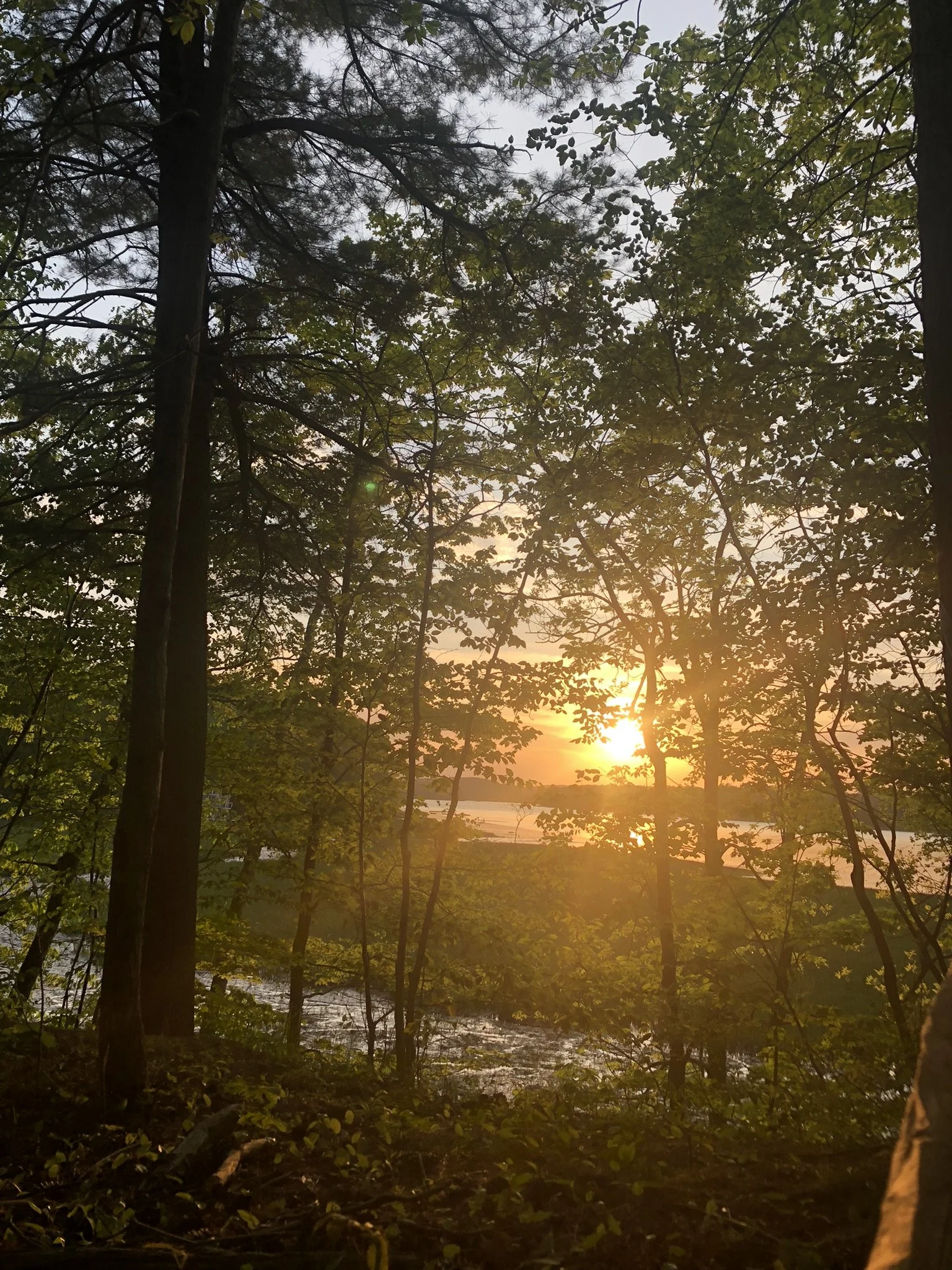
There is a stream that meanders its way through our western woods on the land surrounding Emery House. In one place not far from its union with the Merrimack, the water reliably tumbles over a series of rocks. For a season I made it my discipline to visit this place daily, and its presence drew from me a focal practice that blossomed into an astonishing, intimate relationship. I visited shortly after sunrise. I let the sound of the stream enter me, tumble over the rocks of my thoughts, saturate my intentions. It took time and patience, but I came to feel that the stream herself was teaching me what to do, how to be, in a relationship of mutual presence. When I felt the stream within me, I gently began to shake a rattle. For me this established a connection in the language of sound with the gurgling of the water, the song of the birds, and the rays of morning sunlight. The stream began to sing, or rather I began to hear her song, and this hearing gave me a song to sing in return. Through the harmony of these songs, my song and hers, it was as though I began to hear the eternal Song—the Word—sounding forth from that sacred niche of God’s creation (John 1:1-4). The song of the Creator sings with the voice of every creature. That song is always unfolding—it was long before me, and will be long after me—the song by which the cosmos is sustained. In farewell, I would cross the stream, dip my hands in her waters, and cross myself, as I would with water from a baptismal font.
While going about my day at Emery House, I would often think of the stream, continually flowing out there in the western woods, no matter what I was up to. The stream flowing in the darkness while I slept and dreamt or lay awake sleepless. The stream flowing in the morning and at sunset while I chanted in chapel. The stream praying without ceasing, inspiring me to make my own attempt to do the same. It is a sacrament of the God who is “living water, gushing up to eternal life” and the “river of life” flowing out from the heart of God (John 4:14; Revelation 22:1-2). All this may sound like the work of a wistful, overactive imagination, or perhaps a metaphor run riot, overflowing the banks of reason. But I promise you it is real—at least as real as the words on this printed page or screen. I have come to believe that a stream, this stream, can desire my admiration, my song of love in response to its own sounding song. This reciprocity completes something in me. It is a part of how I am being saved, how I am being made whole. I believe this reciprocity completes something in the work of co-creation, to which Christ calls us to participate. Just as it is part of how I am being made whole, I believe it also is a small part of how creation is being made whole, gathered into the heart of God’s mysterious purposes.
Our ancestors in Christ spontaneously and intuitively cultivated relationships of mutual presence with wild creatures. Countless stories of the saints show us a pattern. It unfolds in the places they called home: the deserts and caves of ancient Syria-Palestine; along the harsh, seaside cliffs of Ireland; and deep in the forests of Russia. In the tales left by their disciples, we encounter servants of Christ befriending lions and jackals, blackbirds and hares, bears and birch trees. Many were monastics, souls worn smooth as river rocks by the ebb and flow of what I would call their focal practices. But this pattern is also intrinsic to the worldview of the Biblical authors. The psalmist cries, “Let the sea make a noise and all that is in it, the lands and those who dwell therein” and “Let the rivers clap their hands and let the hills ring out with joy before the Lord, when he comes to judge the earth” (Psalm 98: 8-9). Jesus urges us: Consider the birds of the air. Consider the flowers of the field. Listen, he urges the Pharisees: if my human followers were silent, the stones themselves would shout (Luke 12:24; Luke 12:27; Luke 19:40). This kind of consideration, this kind of listening, is the fruit of attention and devotion lovingly offered—moment by moment, day after day. Lifetime after lifetime, these have been the habits of the saints. In generous hands, they hold them out to us, their heirs in Christ’s Body.
In other words: this stuff isn’t just for monks wandering around in the woods, or for nuns in caves. It’s for all of us. However distant or disconnected our lives may feel from the restorative power of God’s creation, Life is as near to us as the closest patch of clover and its diamond dew under our bare feet. Life is as near to us as the flour, water, and yeast that yields its supple heft to the pressure of our palms, longing to become bread. Life is as near to us as the sweat that spills from pores and the breath that heaves in lungs as we push through that final turn in the trail toward home.
When we commit to God as our ultimate concern, a deep satisfaction and fulfillment of purpose awaits us. A world of things becomes a cast of collaborators in God’s breathtaking design. It takes practice. But through it, we come to know a foretaste of life that is Life indeed.