The Story of Nicaea
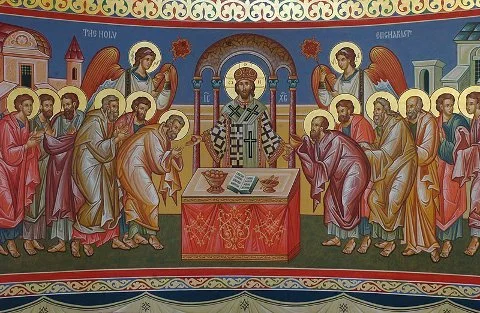
Courtesy of Wikimedia. Public domain.
2025 marks the 1700th anniversary of the Council of Nicaea, but what exactly are we celebrating? The Council of Nicaea (325 CE) holds pride of place in Christian history as the First Ecumenical Council, it is thought to be one of the most decisive moments in the history of Christianity, and it is the origin story of the Nicene Creed, declared by Christians around the world, across denominational lines each Sunday. What happened that was so impactful we keep on reciting the Nicene Creed 1700 years later?
Since the earliest days of Christianity, Jesus’s followers have crafted statements to summarize the teachings of their faith.[1] The earliest Christian statements of faith can be found within the New Testament, in passages such as Colossians 1:15-20, which biblical scholars often understand to be a christological hymn. From the beginning, Christians had pithy ways of summing up their faith.
Throughout the earliest centuries of the church, Christians’ faith statements developed, taking different forms depending on their use. For example, theologians as early as the second century referred to the “rule of faith,” a summary of Christian teaching, when determining whether ideas were orthodox.
Christians also used a credal formula in baptism as early as the second century, wherein the candidate for baptism would be asked a series of questions. By the fourth century, these baptismal questions took a triune form, most likely inspired by Jesus’s great commission at the end of the Gospel of Matthew: “Go therefore and make disciples of all nations, baptizing them in the name of the Father and of the Son and of the Holy Spirit.”[2]
Pseudo-Hippolytus writes in his Apostolic Tradition, that the one baptising was to ask the candidate for baptism these questions:
Dost thou believe in God, the Father Almighty?
Dost thou believe in Christ Jesus, the Son of God, who was born of the Holy Ghost of the Virgin Mary, and was crucified under Pontius Pilate, and was dead and buried, and rose again the third day, alive from the dead, and ascended into heaven, and sat at the right hand of the Father, and will come to judge the quick and the dead?
Dost thou believe in the Holy Ghost, and the holy church, and the resurrection of the flesh?[3]
After each of these questions, the candidate was to reply, “I believe,” and the church leader was to baptize the candidate in the water. In this way, early Christians proclaimed the Trinity and practiced Christianity in a Triunely-marked way.
Throughout the third century, sporadic gatherings took place–sometimes called synods and sometimes called councils–to clarify what teachings and liturgical practices constituted true Christianity.[4] These discussions included questions of Trinitarian doctrine.
The fourth century church found itself in a new situation. Constantine had converted to Christianity, and in 324 he became sole emperor of the entire Roman Empire; Christians were able to peacefully profess their faith all across the empire.[5] When persecution diminished, in-fighting increased. One of the most famous instances of this conflict erupted between two men named Alexander and Arius. The issue? The Trinity.
The story goes that one day, Alexander, who was Bishop of Alexandria, attempted to explain the oneness of the Holy Trinity to the clergy under his jurisdiction.[6] Arius misunderstood Alexander to be taking the view that God only expresses Godself in the modes of Father, Son, and Holy Spirit. In other words, God is one but not three. This view had already been formally rejected by the church. So, Arius responded to this idea by positioning himself against it. The pendulum swung the other way, and Arius argued that if the Father begat the Son,[7] the Son began to exist at some point. There was a time when the Son was not in being, and the Son is part of God’s creation.[8] In other words, God is three but not one.
From Constantine’s perspective, conflict was raging throughout the church, and something needed to be done. Christians were in bitter disputes over the “Arian controversy,” a controversy involving another church leader named Melitius, and whether Easter should be celebrated according to the timing of the Jewish Passover or the Roman calendar’s anniversary of the resurrection.[9] Church unity was at stake.
Eusebius reports on the turmoil across the empire: “While those in Alexandria itself were sparring like juveniles over the highest matters, those around Egypt and the upper Thebaid were at variance on a previous longstanding issue, such that the churches were everywhere divided.”[10] With his signature editorial flourish, Eusebius writes that for Constantine, “this was another war which he must struggle to win against the invisible enemy disturbing the Church. Then, as if to march against him, he marshalled a legion of God, a world-wide Council, with respectful letters summoning the bishops to hasten from every place.”[11]
In reality, a fraction of the bishops throughout the empire were in attendance, and the Roman Empire did not, in fact, account for the whole world. However, this grandiose vision of the coming together of all bishops is part of what made Nicaea feel so monumental to the church. When Constantine called for a gathering of bishops in Nicaea in 325, it was the first time the emperor gathered together the bishops of the entire Roman Empire as a group, under one rule. The Council of Nicaea would not mark the first creed or the first council, but it would mark a major turning point for church unity and polity, with something like three hundred bishops and the emperor gathered together to consider and decide on a range of issues.
At the council itself, it is likely that a few different creeds were posed for consideration before the text of the Nicene Creed was formulated.[12] The creed that bishops signed at the council was similar to creeds that had been floating around bishops and dioceses. However, one significant word was added: homoousios. The creed signed at the council looked like this:
We believe in one God, Father Almighty, Maker of all things, seen and unseen.
And in one Lord, Jesus Christ the Son of God, begotten from the Father, Only-begotten, that is, from the substance (ousios) of the Father, God of God, light of light, true God of true God, begotten not made, consubstantial (homoousios) with the Father, through whom all things came to be, things on heaven and things on earth; who because of us humans and our salvation came down and was incarnate and became human, suffered and arose again on the third day, ascended into heaven, is coming to judge the living and the dead:
And in one Holy Spirit.
And those who say that ‘there was once when he was not’ and ‘before being begotten he did not exist,’ and that ‘he came into existence from nothing’ or who affirm that the Son of God is of another hypostasis or ousia, or mutable or changeable, these the Catholic and Apostolic Church anathematizes.[13]
The Trinitarian proclamation familiar from the baptismal rite is present, but so is this new word. What purpose did it serve? Remember, church leaders were debating about the nature of the Son. Is the Son God or creature? In all likelihood, if these debates happened today, we might use different words more familiar to us, but in the fourth century Greek-speaking world, homoousios was the key to church unity. This is the part of the creed that you might recognize as “being of one substance with the Father” or “of one Being with the Father,” depending on which translation you are most familiar with.
In the fourth century, ousia could refer to a generic, shared being (i.e., flowers in general). Ousia or hypostasis could refer to a specific occurrence of that thing (i.e., the flowers on my kitchen table).[14] The word homoousios described two things as being of the same substance or being–homo meaning same and ousios meaning substance or being. Functionally, the homoousios clause was fuzzy enough for people to feel comfortable signing it, while clear enough that certain theologies associated with Arius were out of bounds. Theologically, homoousios meant that the Son was of the same substance or consubstantial with the Father. In other words, the Son is God.
The idea that the Son was created or did not exist eternally with the Father before creation became out of bounds, as did the idea that the Son was only a portion of the one God. The paradoxical nature of the Trinity as three and one would continue to inspire deep reflection as well as conflict (it is the church we’re talking about, after all).
After the First Ecumenical Council in Nicaea, there were still loose ends. In fact, the creed would not be the Nicene Creed we recognize and recite (more accurately called the Nicene-Constonopolitan Creed) until the Second Ecumenical Council in Constantinople in 381. And yet, as theological conflict raged on, Christians looked back at Nicaea as a significant juncture resulting in a text that Christians were to be faithful to. Bishops at subsequent councils at Ephesus (431), Constantinople (448), Ephesus (449), and Chalcedon (451) spoke of the Nicene Creed’s authority and sufficiency.[15]
As we recite the Nicene Creed each Sunday together, we participate in an ancient practice and connect to our spiritual forebears as we proclaim Scriptural truth about who God is. Its creation was largely in service to church unity, and it lives on as a unifying force. At first, the Nicene Creed unified Christians across an empire, and now it unites Christians not only across the world but also across historical and denominational lines.
———————————————————————————————————————————————————--
[1] Wolfram Kinsig, A History of Early Christian Creeds (Berlin: De Gruyter, 2024), 606.
[2] Matthew 28:19, NRSVUE. The keen, seminary-educated reader may remember that this passage is disputed in the manuscript tradition, which makes this use within church tradition all the more interesting. Scholars disagree about when this credal formulation was first used. For more, see Wolfram Kinzig, Faith in Formulae: A Collection of Early Christian Creeds and Creed-Related Texts, Oxford Early Christian Texts (Oxford University press, 2017), 7, cf. Wolfram Kinzig and Markus Vinzent, “Recent Research on the Origin of the Creed,” The Journal of Theological Studies 50, no. 2 (1999): 535–59.
[3] Ps-Hippolytus, The Apostolic Tradition of Hippolytus, trans. Burton Scott Easton (Cambridge: Cambridge University Press, 1934), §1, p. 47, cf. Young, The Making of the Creeds, 6. It is possible that this particular credal formulation is influenced by the Nicene Creed rather than the other way around.
[4] Graumann, The Acts of the Early Church Councils (Oxford: Oxford University Press, 2021), 13.
[5] Socrates, The Ecclesiastical History of Socrates, Surnamed Scholasticus, or the Advocate: Comprising a History of the Church, in Seven Books, from the Accession of Constantine, A.D. 305, to the 38th year of Theodosius II, including a period of 140 years, trans. Valesius (London: Henry G. Bohn,, 1803), §IV, p. 5.
[6] These are the words the early church historian Socrates uses to explain what happened in Socrates, The Ecclesial History, §V, p. 5. See also Eusebius, Life of Constantine, Book II, §69, 117, for Constantine’s recollection of the issue in his letter to Alexander and Arius.
[7] This concept is seen in the Scriptures we now know as Psalm 2:7, John 3:16, Acts 13:33, Hebrews 1:5, and Hebrews 5:5.
[8] i.e., Rowan Williams, Arius: Heresy and Tradition (London: Darton, Longman and Todd, 1987), 100, 109.
[9] Eusebius, Life of Constantine, trans. Averil Cameron and Stuart G. Hall (Oxford: Clarendon Press), Book III, §5, 123.
[10] Eusebius, Life of Constantine, Book II, §6, 115.
[11] Eusebius, Life of Constantine, Book III, §5, 123.
[12] Wolfram Kinsig, “The Creed of Nicaea: Old Questions, New Answers,” in The Creed of Nicaea (325): The Status Quaestionis and the Neglected Topics, ed. Alberto Melloni and Constanza Bianchi (Göttingen, Germany: V&R unipress, 2025), 31.
[13] Translation by John Behr in John Behr, The Nicene Faith (2 vol.: Crestwood: St. Vladimir’s Seminary Press, 2004), I. 155.
[14] Kinsig, “The Creed of Nicaea: Old Questions, New Answers,” 34.
[15] Mark S. Smith, The Idea of Nicaea in the Early Church Councils, AD 431-451 (Oxford University Press, 2018), 1.