
CREEDS AS LOCI OF INTERCULTURAL ENCOUNTER, PART TWO
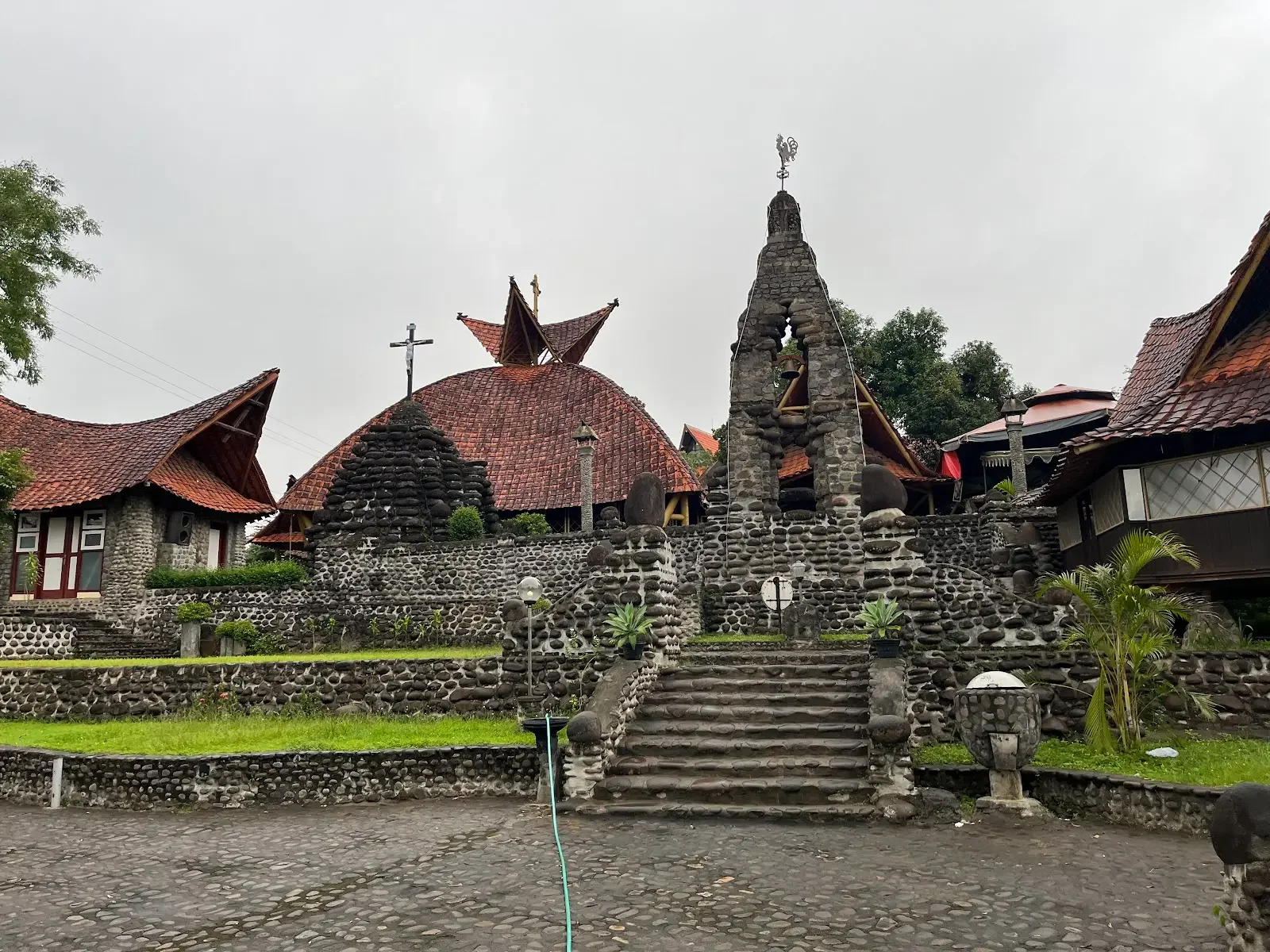
Pohsarang Church in West Java. Public domain.
Editor’s note: this is the second in a four-part series on cultural adaptations of creeds. Check back next week for Part Three!
Cultural translation in Nusantara in colonial Southeast Asia compared with medieval England
We began exploring credal experiments in the first part of this series by setting out some frameworks: the different functions creeds have, the different ways they can communicate information and reshape our understanding, and taking note of their form, the medium of the message. Now we bring these to bear on two translations of the creed, one into Javanese and the other into Old English.
We start in East Java: Conrad Laurens Coolen was the son of a Russian father and Javanese mother who converted to Christianity in his forties and from 1827 led an isolated community of indigenous villagers including those of different religions. He led the Christians in weekly worship services in which the Apostle’s Creed was recited. It was arranged in a native poetico-musical form, the tembang macapat, that continued to be used in communities in central Java in the second half of the nineteenth century. This form consisted of the leader singing the creed punctuated by the community participating in a refrain that recalls the first half of the Islamic shahada (“There is no god but God and Muhammad is his messenger”). This reformulation into an established local performance style is similar to the use of vernacular hymns or folksong melodies in churches. Here there is a specific meter and melody, each significant in the complex Javanese poetic tradition, though we have no contemporary account of the exact wording or transcription of the musical content, the 1891 text-only manuscript transcribed below being from communities that took up the style of inculturated worship he pioneered over half a century prior, with no currently known record of musical notation being transcribed from this tradition, only a description from a missionary journal in 1879 giving the observer’s impression of the rhythmicity and head swaying that accompanied the recitation. Further, the chanting of the shahada is significantly widely practiced by Muslims, from being whispered into the right ear of a newborn, to marking conversion, to being encouraged as a deathbed sign of repentance. The familiarity of the phrase and the poetic quality of the repeated vowels and consonants in the phrase (“Lha illah lha illolah”) likely facilitated the embedding of this practice. We might hear the structural and functional similarities with the ubiquitous Jewish Sh’ma ("Hear, O Israel: YHWH our God, YHWH is one"), and consider that the Sh’ma has been incorporated into Christian liturgies as well.
|
|||||
The practice of repetitive refrain used by Coolens further echoes the practice in Sufi communities as part of dhikr, or ritualized remembrance of God, with repetitive physical movements and sometimes music. In the creation of a communal refrain in a familiar form to accompany the Apostle’s Creed, the original Islamic declaration of absolute monotheism appears to have been modulated by the invocation of both Jesus and the Spirit to comprise what might be read as a Trinitarian formula. The Islamic understanding of the relation of Jesus to the Spirit is somewhat complex, with Akbarian Sufism, an Andalusian tradition known to be transmitted in Java, giving Jesus (Isa in Arabic / Ngisa in Javanese) a unique place among all humans as a receptacle for God’s Spirit with power to give life. However, the citation of “Ruhullah” (God’s Spirit) as an epithet connected with Jesus is derived from the context of differentiating Islamic understanding from what is polemicised as the Christian mistake of tritheism (Qur’an 4:171).
The line “Yesus Kristus ya Roh Allah” is the crux of the matter — is it a heretical pseudo-Islamic perversion of Trinitarianism that claims that Jesus is the Spirit? Both Ricklefs and Partonadi, historians of the period rather than theologians, tend towards this interpretation. Though the Javanese particle “ya” can function as a statement of identity, reading the bare text to prove a mistaken cognitive proposition equating Jesus with the Spirit is perhaps premature. We might consider instead a posture of theological generosity in allowing the irreducible complexity of attempts at divine description some room. “Ya” may also function as an emphatic auxiliary particle, especially in the context of poetic chant, and in any case the verses to which it is a refrain are those of the quite literally translated Apostle’s Creed where Jesus is said to have “nampani roh kang suci” (“received the spirit that is holy”). Such grammatical and theological intersections call to my mind the filioque controversy and the Eastern Orthodox preference for the Spirit processing from the Father through the Son, rather than directly from the Father and the Son, prompting my wild speculation that Coolen’s Russian heritage might even have played a part in this dissent from Western orthodoxy.
The third point I will raise from this historical community is from the separate translation of the Nicene creed into Javanese prose, which has an interesting addition referring to Jesus as a “ratu adil” (just king) whose kingdom will have no end. The concept of the “just king” is very powerful in Javanese culture, being a recurring messianic motif used by generations of kings, revolutionaries, and anti-colonial activists cited from the pre-Islamic Hindu-Buddhist period up to the present day.
Heresiologists on the lookout for transgressive potential may easily read these as dangerous tendencies towards or examples of heterodox syncretism. Yet such concerns may lessen when we compare early English versions of creeds, in particular one found in a monastic compilation as a vernacular Old English expansion of the Latin Apostle’s Creed, from the late eleventh century. We have here a parallel restructuring into a native poetic form, in this case macaronically complex, with the first half of each clause retaining the Latin, while the second half is instead elaborated in strict Old English verse. We have no evidence how it was performed, but Keefer speculates it may have involved an imagined responsorial exchange between leader and community, possibly as a devotional exercise rather than liturgical instruction.[3]
The second point of how Trinitarian nuance may be read into a translated text is paralleled in the statement “ðe fæder sylfne under breostcofan bearn acende,” “the Father himself, bore as a child beneath [Mary’s] heart.” Keefer reads this as tending towards a Sabellian modalism that would have Mary giving birth to the Father.[4] While the linguistic analysis may retain ambiguity or polyvalence, we probably know too little of the doctrinal context to be conclusive regarding the interpretation of “sylfne” as forcing the accusative instead of the dative case — bearing the Father, rather than bearing to or from the Father.[5]
Finally, regarding the incorporation of powerful native cultural metaphors, this creed has “nǣs ðǣr gefremmed firen æt giftum // ac þǣr hālig gāst hangyft sealde” translated by Keefer as "no sin was there committed at the marrying , but the Holy Ghost gave the wedding present” (lines 19–20). Here the distinctly Germanic custom of the wedding-gift (handgyft) is invoked in a vivid nativised metaphorical justification of Mary’s situation, interpretable in an entirely orthodox fashion.
|
|||||
If we dig deeper in what might seem like a barely Christianized sect led by a layperson in the tropical rainforest, we might understand how creeds can be indigenized, even as a Jewish messianic revolutionary movement hybridised with Hellenistic bureaucratic philosophizing to create the Nicene Creed. It survived for a couple of generations after Coolen, with the community expanding to central Java under Sadrach who formed the Golongane Wong Kristen Kang Merdiko (Independent Javanese Christian Community), which used the almanac in which this text was found until the early twentieth century, and continues to influence Protestant churches in Java as an indigenising alternative to the colonial Dutch Reformed Church.
Yoshua Harapap, a pastor of the Gereja Kristen Jawa, GKJ, (the synod of Javanese Reformed churches) reads the community through Bonhoeffer as not merely independent, but a community of liberation, a liberatio communio, situated between a community of sinners and saints, between a peccatorum communio and a sanctorum communio.[8] The specific adaptive mechanisms by which indigenization took place were also paralleled in the British Isles, within a community of monastics that translated the Apostles’ creed, though we have little evidence of the continued impact of that particular text.
In Java this creed had a clear sociological function as a mechanism of initiation. New native converts likely received the creed in a more affective or symbolic vein rather than cognitive, that is, less propositionally definitive than engendering emotions of respect, communality, and associations with culturally familiar motives. Its genre as a weekly call and response community singing ritual, echoing both Islamic and Javanese forms, is surely crucial to thinking about what creeds do. In the medieval Old English creed, cultural-linguistic deepening of understanding was probably at the heart of the monks’ goals for their novices who had little Latin, using surprisingly similar means to the Javanese example. Inculturation continued to be promulgated by the Jesuits in Java, following on from the examples of Coolen and Sadrach, for example by Franciscus van Lith (1863-1926) who “considered that identifying Jesus Christ with Ratu Adil, the ‘Just King’ worshipped by Javanese millenarian movements, could constitute ‘a magnificent starting point from which to announce the good news of the coming of Jesus Christ’.”[9]
______________________________________________________________________________________________________
[1] Sutarman Soediman Patronadi, Sadrach's Community and its Contextual Roots (Leiden: Brill,1990), 134-5.
[2] M. C Ricklefs, Polarising Javanese Society: Islamic and Other Visions, c. 1830-1930 (Singapore:NUS Press, 2007), 111.
[3] “It creates exactly the right design by which to imagine a choir singing the abbreviated but well-known Latin tenets of faith, and a soloist responding with the Old English meditations on each missing section.” in Sarah Larratt Keefer, “‘Worship the Lord in the Beauty of Holiness’: Latin Prayer and Old English Liturgical Poetry,” in On the Aesthetics of Beowulf and Other Old English Poems, ed. John M. Hill (University of Toronto Press, 2010), 110.
[4] Sarah Larratt Keefer, “’Ic’and’We’in Eleventh-Century Old English Liturgical Verse,” in Unlocking the Wordhord: Anglo-Saxon Studies in Memory of Edward B. Irving, Jr., ed. Katherine O’Brien O’Keeffe and Mark C. Amodio (University of Toronto Press, 2003), 136–37.
[5] cf. Mary Clayton, The Cult of the Virgin Mary in Anglo-Saxon England, Cambridge Studies in Anglo-Saxon England (Cambridge University Press, 1990), 209: “bore under her heart the child for you, the Father himself {?}.”
[6] Sarah Larratt Keefer, ed., Old English Liturgical Verse: A Student Edition (Broadview Press, 2010), 83-96.
[7] slightly modified from S. A. J. Bradley, Anglo-Saxon Poetry: An Anthology of Old English Poems in Prose Translation, Everyman’s Library (Dent, 1995), 541–42.
[8] Yoshua Budiman Paramita Harahap, “Liberatio Communio: The Ecclesiological Identity of Sadrach’s Javanese Community,” International Bulletin of Mission Research 41, no. 3 (2017): 239–50, https://doi.org/10.1177/2396939317706446.
[9] Rémy Madinier, “From ‘Mystic Synthesis’ to ‘Jesuit Plot’: The Society of Jesus and the Making of Religious Policy in Indonesia,” Modern Asian Studies 57, no. 2 (2023): 413, https://doi.org/10.1017/S0026749X21000731.
